
Story
Yangon was wet. Not the rain itself — that came in afternoon bursts hard enough to clear the streets in minutes — but the air between the rain. Eighty-five percent humidity at six in the morning, climbing through the day. By midmorning the back of my shirt was dark with sweat. By evening I’d step into the shower in my clothes and peel everything off under the water, washing the day’s salt down the drain. I longed for autumn in Prague. Spring in Helsinki. Anywhere a man could move through a day without losing two kilos of body weight.
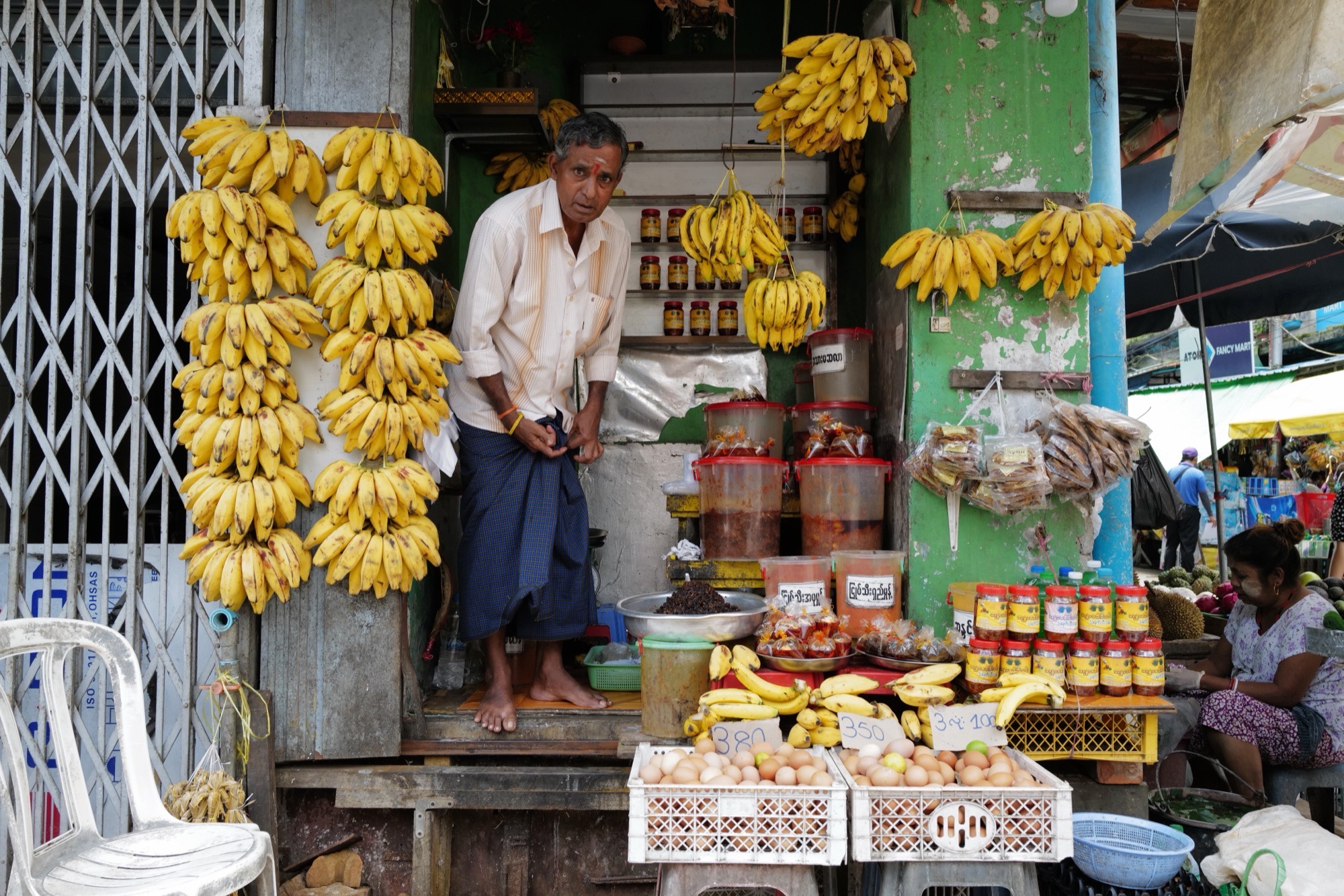
Walking into central Yangon, you wouldn’t have known there was a war. Sule Pagoda still anchored the colonial roundabout. The vendors at Bogyoke market still called out their prices. Monks still walked the morning alms route, robes the colour of wet brick. But the things that should have been there weren’t. The British Council had shut its doors. The American embassy had reduced operations to a single building behind sandbagged walls. Half the storefronts on Pansodan Street had been boarded over and the boards had grown mould. There hadn’t been many tourists since the coup, and there were fewer this year than the last. The country was working hard to be left alone. At Inya Lake, the road past the house Aung San Suu Kyi used to live in was closed off behind concrete barriers and a single bored soldier in a folding chair. He waved me onto a side road without looking up.
My pretext was a tourist. Not a hard one to maintain in a city that had been on every traveller’s must-see list a decade ago and that still had everything that put it there — the Shwedagon, the Strand, the markets, the lake. I’d planned a week. A tourist, even a stubborn one, struggled to fill more than that here. The restaurants that had survived the coup served Burmese curries to mostly Burmese customers, and the menu was what it was. I took photographs. I rode the Circular Railway out into the suburbs and back, three hours of green paddy and shanties and women selling fried snacks through the carriage windows, and arrived at Yangon Central Station no closer to a target but with a notebook full of the right kind of observations.
The Shwedagon was the only place I went twice. The first time at sunset with the rest of the foreign visitors — a German couple, a quiet Russian, a Korean tour group in matching white hats. I lit candles I didn’t believe in. I took the photographs a tourist would take. The second time I went at four in the morning, before dawn, when the marble was cold under bare feet and the only people there were the monks and the old women who came to sweep. I sat for an hour. Watched the sky go from black to grey to gold. Said nothing to anyone. By the time I walked back down the eastern stairway and put my shoes on at the gate, the city was awake and I had a clearer head than I’d had since landing.
The encrypted file had given me a name and three addresses. The man was a colonel in military intelligence and the active partner in three businesses I could verify and probably others I couldn’t — a vehicle import-export firm registered in his wife’s name, a construction company that had won most of the post-coup government contracts in the region, and a karaoke bar on the south side of the city that everyone seemed to know was his. The business was the war. Whoever had paid for the file thought he’d been profiting from it more than fighting it. That was where the file ended, and I’d long ago stopped asking the question of why.
His military base I’d ruled out before I left. Cameras at the gates, armed guards, vehicle barriers, every approach overlooked from inside the perimeter. Not a place I could approach a man, and not a place I could afford to be seen near at all. The construction-company office was in a converted villa behind a high wall in an area where I would have stood out the moment I rounded the corner. That left the karaoke bar.
The bar was on a street with three other karaoke venues and a row of small Chinese restaurants whose plastic chairs spilled onto the pavement. I could sit at any of them with a beer and a bowl of noodles and a phone in my hand and watch the bar’s entrance from across the road for as long as I cared to. I went four nights running, never the same restaurant twice in a row, never the same arrival time, never sitting in the same seat. Two of the restaurants knew me by the third night. The waiter at one brought me a beer before I’d ordered.
The colonel arrived between nine and ten. Always alone in his own car — a Toyota Fortuner, black, late-model, polished. No government plates; he wasn’t on official business when he came here. He parked in the gravel carpark to the side of the building and went through the main entrance and didn’t come out for between three and four hours. The drivers in the carpark gathered in clusters near the back wall, smoking, laughing about things I couldn’t hear. Twelve to fifteen of them most nights. They knew each other.
I attracted the attention I always did. The money changers walking the street. The beggars. The shop owners who watched everything because watching was what you did to stay safe in this country. And on the third night, walking back to my guesthouse from the second restaurant, I picked up a tail.
Two men, perhaps thirty metres back, switching off who took the lead the way they’d been trained to. They followed me around two corners. By the third I was sure. I didn’t turn. I didn’t change pace. I stopped at a tea shop I’d noticed on the previous evening, ordered a Burmese tea, sat with my back to a wall and my phone in my hand and scrolled at nothing for twenty minutes. They didn’t come into the shop. When I left I went the long way home — down to the river, along the Strand, up Pansodan, looping through the market — the route of a man who had got lost and was finding his own way back.
I didn’t try to lose them. Losing them would have told them everything. Instead I gave them a man who took a lot of photographs and stopped at every postcard rack and asked the price of things he didn’t buy. What they were watching for was the kind of foreigner who turns up at the wrong tea shop, talking to the wrong activist, handing over an envelope to someone the regime had its eye on. NGO money flowing to the resistance. A journalist setting up an interview with someone the junta would rather stayed silent. A diplomat reaching out to people no diplomat was meant to reach out to. Mine was the kind of face they’d want to photograph and file away, just in case. But two days of postcard racks would bore them. They were a thin organisation in a country with too many problems. They weren’t going to spend a week on me.
By the next afternoon they were gone. By the night after that I was sure. I went back to the karaoke bar.
The carpark had two ways in. The main entrance, gated and lit, where the cars came and went. And a back fence — chain-link, sagging in the middle, with a gap at one end where someone had pulled a post out of the ground long ago and never put it back. The gap opened onto a yard behind a shuttered furniture workshop. The yard had a drain along its rear wall — concrete, perhaps a metre wide and a metre and a half deep, dry tonight but wet in the rains. Beyond the yard, an alley. Beyond the alley, a street that ran parallel to the one the bar fronted onto. Two corners and I’d be on a different street, walking in a different direction, looking like a different problem.
The colonel parked in the same spot every night. Closest space to the building. The drivers respected it without anyone needing to say anything. There were lights on the wall above his car but they were old fluorescents, half of them flickering, half of them out. The shadows were heavy on the side of the carpark closest to the fence.
* * *
I went in at half past nine, through the gap in the fence, before he’d arrived. I made it ten metres into the carpark, behind a parked van, and stopped. There were six drivers gathered near the back wall. Not the usual two or three. The night had been quiet at the bar and they were standing in a loose ring talking loudly about something — football, probably; I caught two team names. They weren’t going to move for a while. From where I’d planned to wait, I would have been in their direct line of sight every time one of them turned his head.
I stayed twenty minutes. They didn’t move. The colonel arrived. Parked. Went inside. The drivers were still standing there.
I went back out through the fence.
I’d have to try again tomorrow. There wouldn’t be a third chance.
* * *
It rained the next night. Not the slow rain of the afternoon but the harder rain of late evening, drumming on the workshop roofs and turning the carpark gravel to mud. I was through the fence again at nine. The drivers were sheltering — most of them in their cars, two under the eaves of the bar. The carpark was as empty as it was ever going to be.
I waited behind a maintenance shed at the rear, twelve metres from the colonel’s regular spot, in the deepest pocket of shadow the carpark offered. The rain on the corrugated roof above me was loud enough to cover any small sound I might make. The smell of wet gravel, wet tobacco, wet cooking oil from somewhere on the street.
The colonel arrived at quarter past nine. Earlier than usual. Got out, locked the Fortuner, walked to the entrance under the cover of his hand. Inside for three hours and twenty minutes.
When he came out the rain had eased to a steady drizzle. He had a lit cigarette in one hand and his phone in the other, a video playing — a Burmese voice, music, something that sounded like a comedy. He walked towards the Fortuner without looking up.
I moved when he reached for the door handle. Three quick steps. The dagger was already in my hand, lanyard tight around my wrist. I drove the blade into the side of his head, just behind and above the ear, the same place I’d put it before in other men in other cities. The triangular tip found the resistance and then the give. I pushed it deep, pulled it back, and caught his weight against my chest before his knees folded.
Sixty kilograms, maybe. Smaller than he’d looked in the file photo. He smelled of cologne and cigarette smoke and the karaoke bar’s interior — sweat, beer, perfume. I held him under the left arm with the dagger still in his head, walked him three steps into the deeper shadow behind the maintenance shed, and let him down onto the gravel. The phone was still playing the comedy in his other hand. I switched it off.
Through the gap in the fence. Across the workshop yard. The drain had a few inches of standing water from the rain. I rolled him in. He went face down with a soft, contained splash. The water just covered him. The shadow of the workshop wall covered the rest. Anyone walking past wouldn’t have seen him without a torch and a reason to look.
Out of the yard. Into the alley. I checked my sleeve under the next streetlight. Blood on the cuff, not much, dark against the wet fabric. I rolled the cuff up to my elbow and kept walking.
Two corners. A different street. A different problem.
* * *
I walked for forty minutes before I went back to the guesthouse. Not in any hurry. The rain came back partway through and I let it. By the time I reached my room, anyone who tried to find a foreigner in a damp shirt walking through Yangon at midnight in the wet season would have had ten thousand of them to choose from.
The shirt soaked overnight in the bathroom sink with bleach I’d picked up from a corner shop the day before. By morning the cuff was clean and the smell of bleach had filled the bathroom. I rinsed the dagger in boiling water from the kettle, dried it, put it back in its sheath. I went down for the breakfast the guesthouse served — instant coffee, white toast, half a fried egg — and asked the woman at the desk about a day trip to Bago. That afternoon, on the walk back from the market, I dropped the bagged shirt into a public bin two streets from the guesthouse and kept going. I had a couple of days left on my booking. I used them on the trip out to Bago — the reclining Buddha, a roadside lunch, the long quiet drive back through the paddies, watching water buffalo and waiting for nothing in particular.
The local papers ran nothing the next morning. The English-language paper that came with my breakfast had a small story on page four about a senior officer who had not returned home and was being looked for. By the morning after that the story was gone. By the time I boarded the flight back to Bangkok, the colonel was a man whose family was being told to be patient. I cleared immigration at Yangon International without anyone looking twice. The customs officer in Bangkok glanced at my passport, glanced at my face, and waved me through. A small pile of postcards in my bag. I’d never send them.
I sat at the gate for my onward flight and watched a Thai family eat pad thai out of plastic containers and listened to the airport’s announcements cycle through three languages. Just another city. Just another man whose name I wouldn’t bother to remember.
His face, though. The way the comedy was still playing in his hand when he reached for the door. The way the rain had darkened his uniform shirt at the shoulders. That’d stay a while.
They always did.
